Not Giving Up
Watch latest film
Seventeen years ago, unexpectedly, a friend’s basenji pup captured my heart and moved in with me. As I was meditating on what to call him, the letters D-J-I-K-I mysteriously appeared before me. I raced to my computer to look for any references. The only one I found was a nickname for a Cape Verdean singer. I decided that day to name my new singing African basenji friend Djiki (pron. Jeeky). Only recently did I learn that in Mali “djiki” means hope, expectation, or trust.
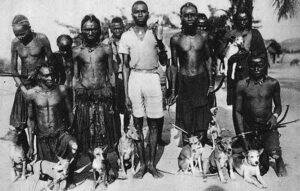
Basenjis are native to Africa’s Congo Basin and are still integral to traditional life there. They are natural chasers and hunters—brave, intelligent, athletic, independent creatures who can stand up on their hind legs like meerkats to survey their surroundings. At times they appear to fly airborne across meadows at high speed.
 Some can even climb trees! Uncommonly, they are both sight- and scent-hounds. Like wolves, basenjis cannot bark. However, like the singing dogs of New Guinea, they can sing, or “baroo.” They also cry, howl, and growl. Although basenjis famously never bark, they definitely are not always silent.
“Soon you’ll be his everything,” a friend told me about Djiki. I’d set up a dog bed for him next to my mattress on the floor, but the pup wanted the warmth and reassurance of sleeping closer to me. He drifted peacefully off to sleep at my side that first winter night. I could tell we’d entered into a secure sleeping arrangement from then on.
We lived at Mt. Hamilton, near the University of California’s Lick Observatory, and hiked every day on the rugged mountain trails. On our hikes, through ancient blue oaks and manzanitas, we’d often encounter wildlife—coyotes, wild boars, hawks, rattlesnakes, deer, foxes, bobcats and, once, a mountain lion in a meadow.
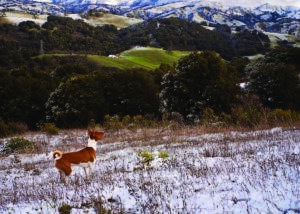
Sometimes at sunset we’d look westward at the expansive panorama of valleys, misty forested coastal mountains, and sea of city lights. Or, on clear winter mornings at the summit, eastward all the way across the Central Valley to the snow-capped Sierra Nevada. Once in a while we could even see Half Dome. I’d hold him and say with a smile, “One day, Djiki boy, this will all be yours!”
After about five years together, I had the feeling that Djiki might like having a basenji pal at home. He was a “latchkey dingo,” often home alone during the hours I was at work, though he had daily walkers and I would go home midday to spend some quality time with Djiki before returning to my nearby workplace while he napped.
To change that situation at home, I decided to take in a playful five-month-old basenji named Jack. For the first few days, it seemed I’d seriously miscalculated—Djiki expressed his displeasure from the get-go. Jack was a good sport, though, and it paid off after just three days. In a move that took me by surprise, Djiki welcomed the newcomer on the bed for the first time and a new alliance was born: the Djiki-Jack Pack. We three—all seniors now more than a decade later—still go everywhere together.

Although they look alike, their personalities are different. Djiki usually walks in a straight line; Jack always zigzags. At 17, my independent Djiki is now my constant shadow, while Jack befriends every person and dog he encounters. A sure sign that Jack likes you is when he quietly sits on your foot and serenely looks up at me with his soulful amber eyes, signaling his acceptance of you—and maybe also wanting to make me a little jealous. If Djiki could roll his eyes at Jack’s performance, he would.
We often encounter people who stop and ask with amazement, “Are they basenjis?!?” That usually leads to stories about basenjis they’ve known, or questions about the primal breed and what it’s like to live with them.
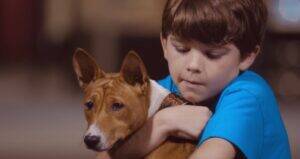
One day, a young boy playing with his friends in a park came over to ask me about them. I told him they were the world’s oldest kind of dog.
He looked puzzled, thought for a moment, then politely asked, Why are they still alive?
In 2015, marking a milestone birthday and inspired by his basenji companions Djiki and Jack, David Whitman was searching for a way to help companion animals who needed homes. His longtime friend and mentor, Sally Hazard Bourgoin, encouraged him to explore ideas with the president of Humane Society Silicon Valley, Carol Novello, leading to the creation of Mutual Rescue and release of their first film, “Eric & Peety,” in 2016. With more than 100 million views that year alone, the film motivated innumerable people worldwide to embark on their own mutual rescue journeys.

Mutual Rescue’s films, book, and programs illustrate how “mutual” and “rescue” so often converge when people help homeless companion animals.

